
Parkland Previous-Resident Sources
Parkland previous residents appear in sources built for different jobs. The current parcel card is the starting point, while deeds supply the ownership chain. Directories and census schedules can add occupants who never appeared on title. Permits, aerials, probate, and obituary evidence help date changes or explain why a name disappears.
| Source | Local time span | Custodian | Useful evidence |
|---|---|---|---|
| Official Records | Full from July 7, 1977; limited from March 9, 1972 | Broward Records, Taxes and Treasury | Deeds, liens, plats, mortgages |
| Older deeds | Before March 9, 1972 | Search & Copy or film | Earlier transfers and parties |
| Suburban directory candidate | 1975–1986 | Broward Main Library | Name, phone, address if Parkland is covered |
| Federal census | Through 1950 public | NARA and library databases | Households on census day |
| Permits and aerials | Coverage varies | Parkland and Broward County | Work dates and development timing |
No source is a complete roster. Use a recorded owner as a lead, then seek an independent source before identifying a person as an occupant. Broward's exact cutoffs also prevent false confidence about what a blank online result means.
Start Parkland History With Folio
The Broward County Property Appraiser search connects the physical, or situs, address to a folio, owner, legal description, subdivision, lot and block, sales references, exemptions, and a map. Save the full legal description. A mailing address is where tax mail goes and may differ from the home. Likewise, a homestead flag supports an owner-occupancy inference, but does not list a full household.
The folio is especially useful when searching previous residents because old deeds may omit the modern street address. Compare the legal description and parcel identity at every link. A quitclaim, trust transfer, or entity name may change the indexed parties without representing a normal sale. Check each record date against its execution date, since those dates can differ.
Note: The parcel card identifies the owner of record, not every person who lived at the Parkland address.
Walk Broward Deeds Backward
The Broward Official Records index provides Name, Book/Page, Document Type, Instrument Number, Case Number, Consideration Amount, Date Recorded, Simple Search, and Parcel ID modes. Start with the present owner's acquisition deed and work toward earlier buyers. An index entry is a finding aid; the deed image or certified copy is the record to rely on.
- Copy the current owner, folio, legal description, and sale citation from BCPA.
- Open the acquisition deed and record its grantee, grantor, instrument, dates, and legal description.
- Search that seller as a grantee to find the seller's earlier purchase.
- Repeat with initials, spouse names, trusts, entities, parcel ID, or book and page when names shift.
- At the online boundary, call Search & Copy at 954-831-4000 for film and earlier records.
- Grantor and grantee
- The grantor transfers an interest; the grantee receives it.
- Chain of title
- The linked sequence of recorded transfers for the same land.
- Legal description
- The lot, block, subdivision, or survey wording that identifies land apart from its mail address.
Cross Parkland's Online Cutoff
Timing matters. Official Records is fully searchable from July 7, 1977 at 1:47 p.m. A limited span begins March 9, 1972 at 11:28 a.m. and runs to the full-search cutoff. Before that, deeds are absent online, though plats and maps are indexed regardless of date. The limited range can be reached by instrument, book and page, or record date.
Older work moves from the portal to county Search & Copy or film. Published charges are $2 per name per year for an official-record search, $1 per ordinary copy page, and $2 per certified instrument; oversized maps or plats are $5. Ask for inspection when a copy is not needed. This boundary is vital in a search for previous residents because “no result” may mean “not digitized.”
Pair Parkland Directories and Census
Ownership is only half of a house history. The Broward Main Library fifth-floor directory database searches names, phone numbers, and addresses. Its Fort Lauderdale Suburban run covers 1975–1986 and may bridge Parkland's early growth, but the published guide does not confirm Parkland coverage. Ask staff to test the exact address and edition before citing it. The fuller collection details belong in the Parkland city directory material.
- Search the exact address and record the edition, spelling, and phone number.
- Repeat in adjacent years and try the legal subdivision when the street form fails.
- For 1950 or earlier, locate the address in the public federal census and note the enumeration district.
- Compare names across deeds, directory editions, census households, and newspapers.
An enumeration district is the small area assigned to one census taker. The 1960 census will not open until 2032 under the 72-year rule. Parkland incorporated in 1963, so earlier land may be cataloged as unincorporated Broward rather than Parkland.
Parkland's Changing Record Geography
Broward County was formed in 1915 from parts of Dade and Palm Beach counties. Parkland incorporated on July 10, 1963, then expanded more than twentyfold during the 1970s. First paved roads arrived only in the 1980s. These shifts explain why a long Parkland-only directory shelf does not exist and why early records may use another county, subdivision, or regional place label.
For pre-1915 land, determine whether the historic custody lies with Dade or Palm Beach records. For later work, plats and the legal description connect a parcel through new streets and subdivisions. No official Parkland-wide street renumbering was found, so a changed number should be proved from plats, permits, or directories rather than assumed.
Date a Parkland House
County aerial sets cover 1962–2000, with special 1947 and 1955 imagery, while BCPA imagery extends through 2012. Aerials can show when a road, roof line, or group of lots first appears. They do not name previous residents. Parkland permit records add applicants, owners, contractors, work descriptions, and certificate details.
The city now uses MyGovernmentOnline for building services; the prior system is unavailable, and new fees took effect October 1, 2025. The city forms page also offers a Records Retrieval Request with view-only and copy choices. The published retrieval fee is $25, and the form asks for address, lot or block, subdivision, and certificate-of-occupancy date. Together, aerials and permits establish the building timeline before names are attached.
No Parkland Sanborn Shortcut
Sanborn fire-insurance maps often help with urban house history, but no Parkland sheet was found. Fort Lauderdale's 1918 sheets and later regional maps document the urban core, not Parkland houses. Treating them as local evidence would create a false trail.
The stronger Parkland substitute is the Broward environmental-research guide, which joins directory runs, old telephone books, BCPA records, and historic aerials into one address workflow. Plats can also remain searchable even when the deed book itself requires film. That contrast makes the plat a useful bridge, not proof of who lived there.
Close a Parkland Resident Trail
A deed can end with an estate, trust, or personal representative rather than the person sought. Search the Broward Clerk's probate docket, then compare names and dates with local newspaper evidence. Probate may identify a personal representative, interested parties, and filings, although remote images can be restricted. Older files are requested from Archives at the Central Courthouse.
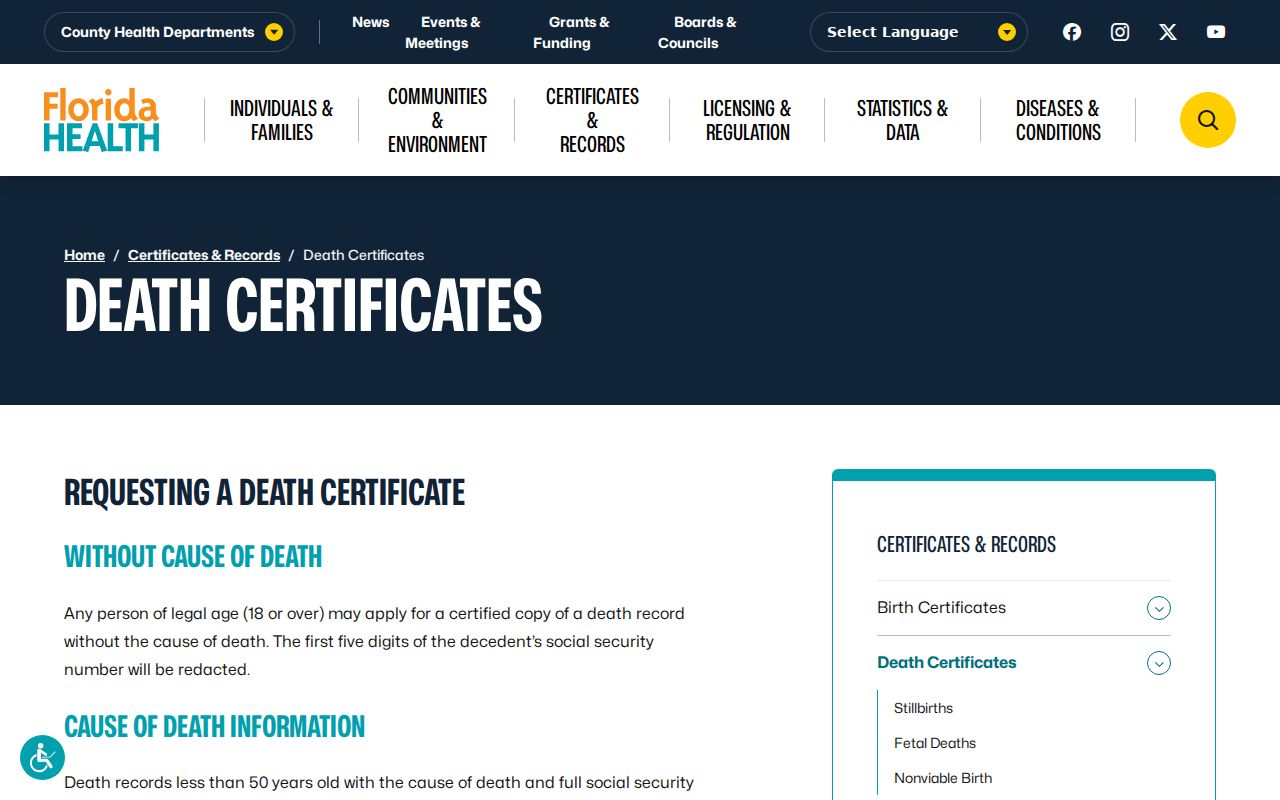
Broward County Library accepts obituary-search requests through periodicals@broward.org and cautions that not every death was reported. Sun-Sentinel full text begins in 1986, with page-image and microfilm access at the library. The statewide Florida death-certificate guidance explains that copies without cause are public to adults, while cause of death remains confidential for 50 years and Social Security numbers stay confidential.
The official certificate page below helps separate public details from protected data.
Use Previous-Resident Records Lawfully
Public records can support family history, estate research, and an account of how one Parkland parcel changed. They still contain gaps. Owners may never have occupied the home, renters may leave no address-indexed public trace, and protected people may use substitute addresses. Verify a living person through direct, respectful contact before drawing a conclusion.
Florida's Address Confidentiality Program and section 119.071 protect qualifying addresses and sensitive fields. Birth records under 125 years old are confidential. Utility and motor-vehicle data are not a public household directory. These limits are part of an accurate previous residents search, not obstacles to work around.
When the trail reaches a marriage or divorce, use the correct custodian and date range. Broward Clerk marriage licenses from 1915 through 1997 are purchased in person at Marriage Central, while 1998-present copies are available at central and regional courthouse sites. A mail request includes both names used at application, the marriage date, payment, and a stamped return envelope. The published wait is at least two weeks. State marriage and dissolution abstracts begin June 6, 1927; earlier local material remains with the Clerk. These records can connect surnames that change between a deed, directory edition, probate docket, and obituary, but an abstract does not prove residence at the parcel.
For a harder case, record negative findings as carefully as positive ones. Note the exact portal mode, name variant, parcel ID, date span, and directory edition checked. Then ask Broward Main Library staff about older phone directories, microfiche, or an obituary request, and ask the county custodian about unavailable deed images. This audit trail keeps two people with the same name from being merged and makes later rechecking possible when another source is digitized.
Lawful use. Research a Parkland house for history, family, or an estate. Never use a record trail to watch, threaten, or harass a living person.